
You signed up with a new broker on a Tuesday. The packet came as a PDF — W-9, insurance cert, banking details, a carrier agreement running eleven pages. You had a truck sitting in Brampton and a load you wanted covered by Thursday. You signed it in four minutes.
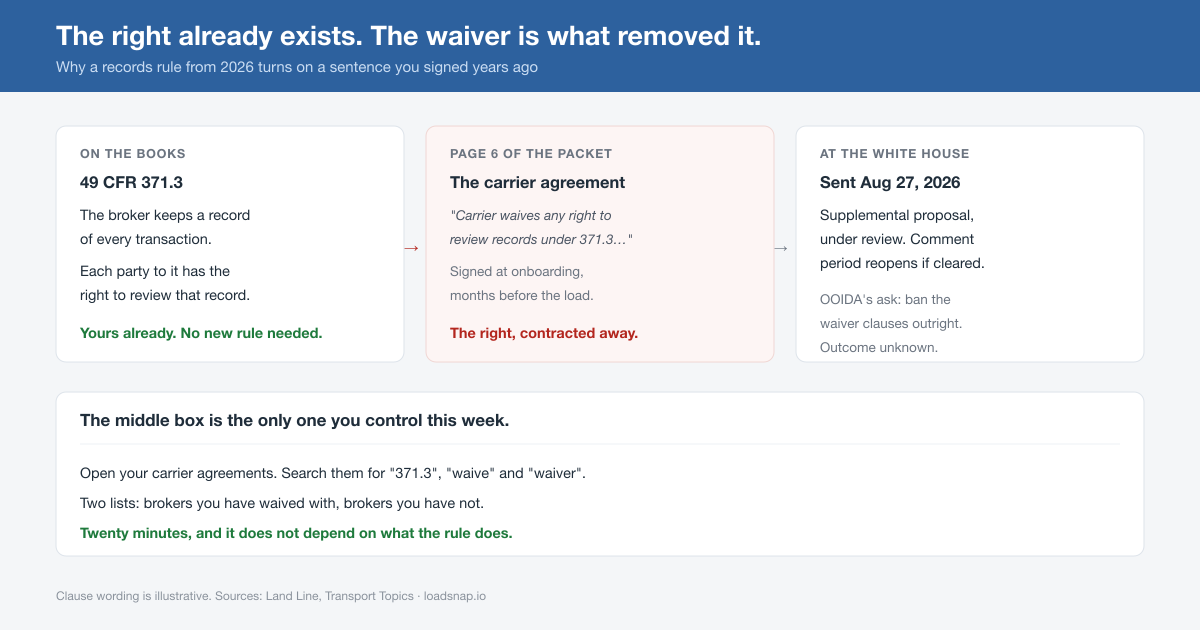
Somewhere around page 6 was a sentence about your right to review transaction records under 49 CFR 371.3, and your agreement to waive it.
You’ve hauled forty loads for that broker since. You have never known what the shipper paid on any of them.
The rule everyone is watching is not the part that matters
On August 27, FMCSA sent a supplemental freight broker transparency proposal to the White House for review. It has been a slow six years: petitions from OOIDA and the Small Business in Transportation Coalition in 2020, a proposed rule in November 2024, thousands of comments, a change of administration, and a decision to restart rather than finalise. The 2024 version would have required brokers to keep transaction records electronically and hand them over within 48 hours of a request — charges, payments, shipment descriptions, dates, claims.
The Transportation Intermediaries Association opposed it as “rate intrusion.” The American Trucking Associations opposed it too. Neither is a surprise.
Here is the part that gets lost in the coverage, and it is the only part that changes what you do this week:
You already have this right. It has been on the books for decades.
49 CFR 371.3 requires a broker to keep a record of each transaction, and it gives each party to that transaction the right to review it. Not “may request.” Has the right. You did not need a new rule to look at the record of a load you hauled.
So why does nobody see these records?
Two reasons, and neither is the regulation. The first is that some brokers simply decline and dare you to do something about it — the enforcement path is a complaint, and complaints take longer than your next fuel bill. The second is the one that actually binds: the broker wrote a waiver of your 371.3 rights into the carrier agreement, and you signed it.
That is why OOIDA’s central ask was not “give carriers a right.” It was that FMCSA prohibit contract provisions that waive carriers’ access rights. The right was never the missing piece. The waiver is.
Why this is worth your attention at all
Not for the reason most people assume. Knowing a broker’s margin on a load you already hauled and already got paid for changes nothing about that load. Being angry about it is not a business strategy, and brokers are entitled to a margin — they carry the credit risk, the collections, and the shipper relationship.
The value is forward-looking. The transaction record tells you what the shipper pays on that lane. That is the number you have never had when you sit down to renegotiate, and it is the number the broker has had the whole time. A rate conversation where one side knows the shipper’s price and the other is guessing is not a negotiation. It is an auction with one informed bidder.
Which means the useful question is not “what did they make on load 4471.” It is “what does this lane actually pay, so I know whether my rate is low.”
Seven things to check today
- Search your carrier agreements for “371.3”. Open the PDFs, hit Ctrl-F. Do it for every broker you run for. This takes about twenty minutes and it is the whole job.
- Also search for “waive”, “waiver” and “transparency”. Some packets never cite the regulation number — they describe the waiver in plain language instead.
- Make a two-column list: brokers you have waived with, brokers you have not. Most carriers have never seen this list and are surprised by it.
- Check whether it’s in the agreement or the rate confirmation. A waiver buried in a rate con is agreed to per-load, which means the next load is a fresh chance to strike it.
- On your next new broker packet, strike the clause before signing. Line it out, initial it, return it. Some brokers will accept the edit without comment. The ones that refuse have told you something useful for free.
- Ask on lanes you’ve stopped running, not on the load you’re mid-haul on. The right is real; so is the relationship, and a records request on live freight reads as a fight. Contract renewal is the natural moment.
- Watch for the comment period. The supplemental proposal will reopen public comment when it clears review. That is your one cheap chance to be on the record.
The email, if you decide to send one
Keep it flat and procedural. This is a records request, not an accusation — and the tone decides whether you get an answer or a lawyer.
Don’t send this:
Subject: Rate transparency

I know you guys made a killing on these loads and I want to see
the numbers. I have a right to them.
Send this:
Subject: 371.3 records request — loads 4471, 4482, 4501

Hi [name],

I'm reviewing our lane performance for the year and would like to
request the transaction records for the loads below, per 49 CFR 371.3.

  Load 4471 — Mississauga, ON → Columbus, OH — Jun 3
  Load 4482 — Mississauga, ON → Columbus, OH — Jun 17
  Load 4501 — Mississauga, ON → Columbus, OH — Jul 8

Electronic copies are fine. No rush on my end — whenever is
convenient this week.

Thanks,
[name] · MC ###### · [carrier]
Three loads on one lane, not forty across the book. A narrow request on a specific lane is a business question. A blanket demand for everything is a discovery request, and it gets treated like one.
Do this today
Open one carrier agreement — the broker you run the most freight for — and search it for “371.3”. That’s it. Whether the clause is there or not, you will know something about your largest customer that you did not know this morning, and you will know it before the rule lands rather than after.
None of this is about sending more email. It’s about the twenty minutes a week you don’t spend retyping a lane into a broker inquiry, so there’s time left to read the agreement you signed. LoadSnap sends the broker email in one click from LoadLink, DAT and Truckstop — the lane, the equipment and your MC number already in it — and keeps a record of which broker you contacted about which lane, which is exactly the list you need when you decide who to ask.
Related reading: Brokers Don’t Pick the Best Carrier. They Pick the First Credible One. and Spot Is Up 35%. Contract Is Up 11%. That Gap Is Your Window.
Sources: Land Line · Transport Topics