You saw the load at 7:02. You pulled the rate, checked the lane, made the call at 7:09.
Covered.
You were qualified. Right equipment, right area, you’d have taken the rate. You didn’t lose on price and you didn’t lose on service. You lost because five other carriers answered first — and one of them answered completely.
What actually happens on the broker’s side
A broker posts a load and gets a burst of responses in the first few minutes. They are not sitting there ranking carriers by quality. They are trying to cover the load and get to the next one.
So they work down the responses until they hit one they can say yes to without asking a follow-up question.
That’s the whole mechanism. Not the best response. The first one that doesn’t create more work.
Every time a broker has to write back “what’s your MC?” or “where’s the truck right now?”, that’s a round trip. Ten minutes if you’re at your desk. An hour if you’re driving. And in that gap, somebody else answered with everything already in the message.
You weren’t rejected. You were still in the queue when the load left.
The six things that make a response complete
A broker cannot commit to you until they know all six of these. Miss one and you’ve bought yourself a round trip:
- MC or DOT number — so they can run you before they reply
- Equipment type — van, reefer, flatbed, and any specifics that matter
- Where the truck is right now — not your office address, the truck’s actual position
- When it’s available — a date and a time, not “soon”
- Your rate — a number, or an explicit “what’s your best on this”
- A direct callback number — the phone that gets answered in the next ten minutes
Six items. That is the entire difference between a message that books a load and a message that sits unread.
Most carriers send three or four and wonder why the good loads always go to someone else.
The same enquiry, two ways
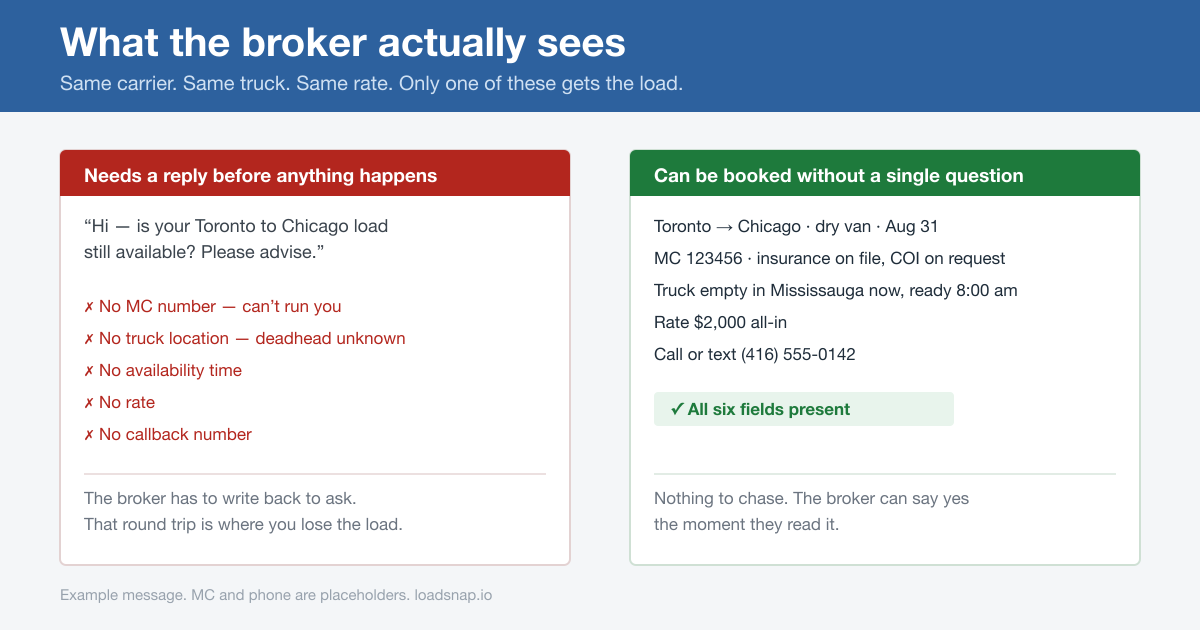
What most carriers send:
Hi — is your Toronto to Chicago load still available? Please advise.
Nothing there is wrong. It’s just unanswerable. The broker cannot do anything with it except type a reply asking who you are.
What gets booked:
Toronto → Chicago, dry van, Aug 31 MC 123456, insurance on file, COI on request Truck is empty in Mississauga now, ready 8:00 am Rate: $2,000 all-in Call or text: (416) 555-0142
Same carrier. Same truck. Same rate. One of them can be booked the second it’s read.
Notice it isn’t longer in any way that costs you time — it’s five short lines. It’s just complete.
Why the phone is quietly losing you loads
Calling feels faster. It usually isn’t.
A call is synchronous: it only works if the broker happens to be free at that exact second. On a busy morning they are not. You get voicemail, or thirty seconds of a distracted person who writes nothing down and forgets you by the next call.
Email is asynchronous, and more importantly it’s a written record. All six fields land in one place. The broker reads it when they surface, and your details are already sitting in their inbox at the moment they’re ready to cover.
The carriers booking the most loads are not calling more. They’re arriving first, in writing, complete.
Don’t overcorrect into a long email
The opposite mistake costs you too. A broker skimming twenty responses will not read three paragraphs about your safety record.
Five lines. Six facts. No introduction, no pitch, no “we pride ourselves on”. If they want your history they’ll ask — and by then you’ve already got their attention.
Complete is not the same as long. Complete means nothing is missing. Short means it can be read in four seconds. You need both.
The real reason you’re slow
Here is the uncomfortable part. It isn’t effort. It’s keystrokes.
Every response means opening a new email, retyping the load number, origin, destination, equipment, your MC, your insurance status, your callback number. Two minutes if you’re quick.
Two minutes is nothing once. Do it forty times in a morning and you’ve spent over an hour typing the same seven facts — and you were still sixth on every load, because the carrier who beat you had it templated.
You are not competing on hustle. You are competing on how long it takes to get seven known facts into a broker’s inbox.
Do this today
Write one template. Not ten. One, with your MC, insurance status and callback number already in it, and blanks for the load-specific details.
Send that instead of typing from scratch. You’ll see the difference inside a week — not because your rates improved, but because you stopped arriving sixth.
Then get rid of the blanks too.
That’s what LoadSnap does. It sits on top of LoadLink, DAT and Truckstop and sends your template with the load’s details already filled in, one click, straight from the board. No new tab, no retyping, no missing field. The response is complete because it can’t be incomplete.
You still choose the loads. You just stop losing the ones you’d already qualified for.
Next: 10 copy-paste email templates for freight dispatchers — including a first-contact template with all six fields built in. Expanding into new lanes? Which load board covers what.