
You pull up the board Monday morning, look at the dry van average, and feel slightly better than last week. The number moved up a penny.
It did. And you got paid less.
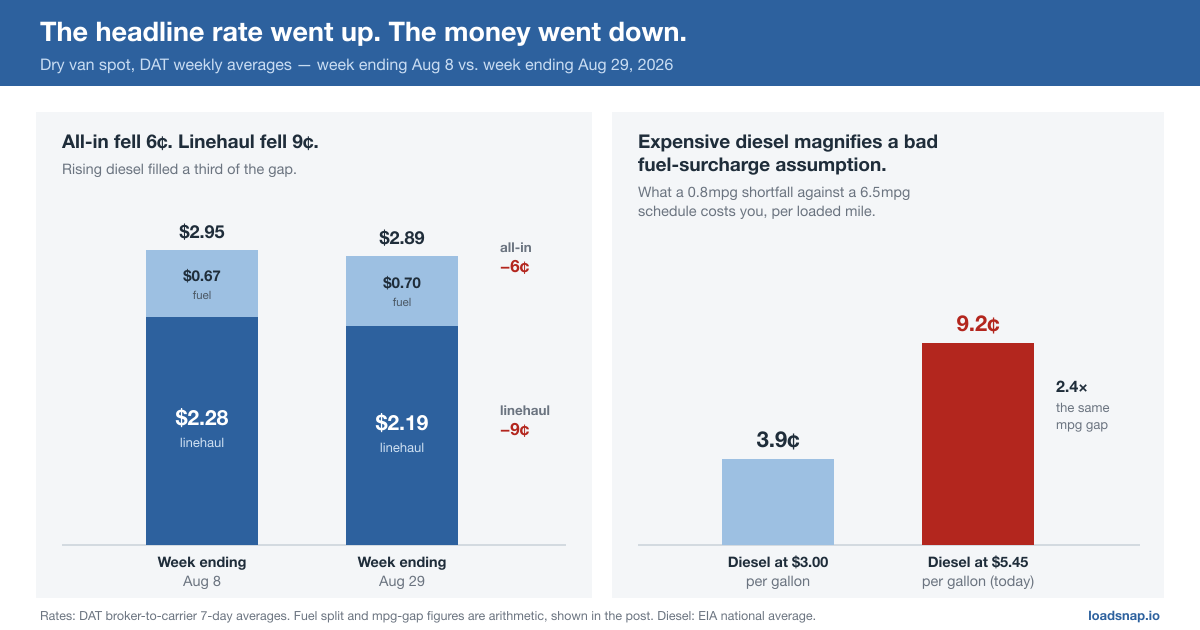
For the week ending August 29, DAT’s broker-to-carrier dry van average came in at $2.89 a mile all-in, up 1 cent. The linehaul on the same freight was $2.19 a mile, down 2 cents. Three weeks earlier, week ending August 8, it was $2.95 all-in and $2.28 linehaul. So over that stretch the headline fell 6 cents and the part that actually pays you fell 9 cents.
The difference is diesel. The EIA national average used in that week’s surcharge math was $5.454 a gallon, up 19.7 cents from the week before. That increase pushed the fuel side of every rate up, which propped up the all-in number while brokers were quietly paying less for the freight itself.
The all-in rate is two numbers wearing one coat
Everybody knows a rate has a fuel surcharge in it. Almost nobody prices against it, because for a decade the fuel piece was small enough to ignore.
It isn’t small now. Subtract those published averages and the fuel component for the week ending August 29 was 70 cents a mile — 24% of the all-in rate. Nearly a quarter of the number you are negotiating against is not a price at all. It is a reimbursement for money you already handed to a truck stop.
Two consequences fall out of that, and both cost real money.
One: fuel movement fakes market movement. When diesel jumps 20 cents a gallon, every all-in rate on the board rises a few cents without a single broker deciding to pay more for freight. If your gut check for “is this a good rate?” is a dollars-per-mile all-in number you carry in your head, a fuel spike reads as a strengthening market. Late August was exactly that. The board looked flat to up. Freight pricing was falling.
Two: high diesel amplifies every flaw in the surcharge schedule. This is the part almost nobody has had spelled out.
The mpg assumption you never agreed to
A fuel surcharge is built from two numbers the broker picks: a base fuel price below which no surcharge is paid, and an assumed miles per gallon. Take today’s diesel minus the base, divide by the assumed mpg, and you get cents per mile.
Say the base is $1.20 and the schedule assumes 6.5 mpg. At $5.454 diesel:
- $5.454 − $1.20 = $4.254 per gallon of surchargeable cost
- $4.254 ÷ 6.5 = 65.4 cents per mile paid to you
Now run your actual truck. Loaded to 42,000 lbs, in traffic, with a reefer or a headwind, plenty of trucks turn 5.7 mpg on that lane rather than 6.5:
- $4.254 ÷ 5.7 = 74.6 cents per mile of real cost
- 74.6 − 65.4 = 9.2 cents a mile you eat, straight out of linehaul
On a 1,200-mile run, that is $110.40.
Here is why it matters more now than it did two years ago. Same truck, same 0.8 mpg gap, but diesel at $3.00 a gallon:
- $3.00 − $1.20 = $1.80 ÷ 6.5 = 27.7 cents paid
- $1.80 ÷ 5.7 = 31.6 cents of cost
- 3.9 cents a mile you eat, or $46.80 on the same run
The mpg gap didn’t change. The cost of the gap went up 2.4 times, because expensive fuel multiplies the error. Every mismatch between the schedule’s assumptions and your truck is worth more than double what it was.
The base peg does the same thing. Illustrating with two pegs against the same 6.5 mpg schedule at $5.454 diesel: a $1.20 base pays 65.4 cents a mile, a $2.00 base pays ($5.454 − $2.00) ÷ 6.5 = 53.1 cents. That is 12.3 cents a mile of difference — $147.60 on 1,200 miles — decided by a number in a document you have probably never asked to see.
Seven things to check this week
- Find out what you actually got paid in linehaul last month. Not gross, not revenue per mile. Total settlement minus total fuel surcharge, divided by loaded miles. That is your real number.
- Ask one broker for their fuel surcharge schedule. The base price and the assumed mpg. If the answer is “it’s in the rate,” that is the answer.
- Measure your own loaded mpg on your three regular lanes. Not the ECM lifetime average — loaded, on those lanes, this season.
- Compare the two. If your real mpg is below the schedule’s assumption, you are funding the difference on every mile.
- Check whether the rate con separates linehaul and FSC at all. If it says one all-in number, you have no basis to argue fuel when diesel moves mid-week.
- Re-price your reefer and heavy loads first. They have the worst mpg, so they absorb the largest shortfall.
- Stop quoting a target all-in number. Quote a linehaul number and take the surcharge on top of it.
The one line that changes the conversation
Most carriers reply to a load posting asking for a rate. That gets you an all-in number and no way to read it. Ask for the split instead — it takes four extra words and it changes what you learn.
Before:
Hi, is this load still available? What’s the rate? Thanks.
After:
Hi — 53’ dry van, Mississauga to Columbus, empty now, can be under it at 8:00 am tomorrow. MC 123456, $100k cargo, WSIB and COI on file, ready to send. Two questions: what’s the linehaul, and what fuel surcharge schedule is it on — base price and assumed mpg? I’ll confirm inside 10 minutes.
The second one gets a faster answer, because it also does the credibility work a broker needs before they will talk numbers with you at all — the same reason brokers cover loads with the first complete reply rather than the best carrier. And it puts the FSC schedule on the record before you commit the truck.
Do this today
Pick your single highest-volume broker. Send one email asking for their fuel surcharge schedule — base price and assumed mpg — and nothing else. One email, one broker. If their assumed mpg is above what your truck actually turns loaded, you have found a leak that has been running the whole time diesel was climbing.
Where LoadSnap fits
Most dispatchers send the short version because the long one has to be typed forty times a day, on top of copying lane and equipment out of DAT, Truckstop or LoadLink by hand. That is why the good questions get dropped.
LoadSnap is a Chrome extension that sends your template as a personalised email in one click, straight from the load posting, with those details already filled in. You write the linehaul-and-schedule question once. After that it goes out on every load, and the fuel surcharge stops being something you find out about on the settlement.