
Every few months, a trade policy headline lands and the group chats light up. Tariffs on steel. Tariffs on autos. Retaliation from Ottawa. New rules of origin. Somebody forwards a news article, everybody argues about it for a day, and then Monday comes and you still have to decide which loads to bid on.
That gap — between the headline and the decision — is where carriers lose money.
The headline tells you a rate changed. It does not tell you which of your lanes just became a deadhead risk, which broker is about to stop calling, or whether the surge you’re seeing this month is real demand or borrowed demand that will vanish in six weeks.
This post is about closing that gap. Not by predicting policy, which nobody can do reliably, but by understanding the mechanism — how a duty change on a customs form turns into a rate change on your load board. The mechanism is stable even when the politics aren’t. Once you can see it, you can position ahead of the move instead of reacting after it.
How to use this post. Written August 2026. Specific duty rates, effective dates, and exemptions change constantly, and this is not customs or legal advice — verify current treatment for your commodities with U.S. Customs and Border Protection, the Canada Border Services Agency, or a licensed customs broker. What’s below is the freight-market mechanics, which move a lot slower than the policy does.
Table of Contents
- Why trade policy moves freight at all
- The five mechanisms
- The backhaul trap
- What it means for your equipment
- The decision playbook
- Indicators worth watching
- Where speed becomes the edge
- Your next 30 days
- FAQ
Why trade policy moves freight at all
A tariff is a tax on a good crossing a border. That sounds like an importer’s problem, not a carrier’s. But freight is a derived demand — nobody moves a truck for its own sake. Every load on your board exists because somebody decided to buy something from somewhere.
Change the cost of buying from somewhere, and you change three things at once:
- What gets bought — volume goes up or down
- Where it’s bought from — sourcing shifts to a different country
- When it’s bought — purchases get pulled forward or pushed back
Only the first one shows up in the news. The second and third are what actually reshape your lane map. A sourcing shift from Asia to Mexico doesn’t reduce freight — it moves it from a port drayage lane in Los Angeles to a cross-border lane in Laredo. Somebody’s business dies and somebody else’s doubles, and the total volume barely moves.
Your job is to know which one you are, early.
The five mechanisms
1. Pull-forward: the surge that isn’t growth
When a tariff has an announced future effective date, importers race to land goods before it hits. Orders accelerate, ocean bookings spike, ports congest, drayage tightens, warehouses fill.
This feels fantastic. Spot rates rise, your phone rings, brokers get agreeable. It is the single most dangerous moment in the cycle, because the volume is not new demand — it’s demand borrowed from next quarter.
Carriers who read a pull-forward as growth do the natural thing: add a truck, add a driver, take on a payment. Then the deadline passes.
2. The air pocket: paying the surge back
After the effective date, volumes drop below trend, because the next few months of buying already happened. Warehouses are full, so replenishment orders stop. Spot rates fall. The brokers who were agreeable in month two stop returning calls in month four.
The air pocket is usually shorter than carriers fear and deeper than they expect. The carriers who get hurt aren’t the ones who saw it coming — they’re the ones who added fixed cost during the surge.
The rule: treat pull-forward revenue as one-time revenue. Use it to pay down debt or build a cash cushion, not to underwrite a new truck payment. If you’re going to add capacity, add it on the back of the air pocket, when equipment and drivers are cheap, not at the top.
3. Gateway shift: the map redraws
Tariffs are rarely uniform across countries. Different rates by origin mean importers re-source, and re-sourcing changes which door the goods come through.
Goods that shift from overseas to North American production stop arriving at a seaport and start crossing at a land border. Goods that shift the other way do the reverse. The freight doesn’t disappear, it relocates — and a lane that has been reliable for you for five years can thin out over two quarters without anything appearing to be “wrong.”
This is the slowest mechanism and the most consequential. Sourcing decisions take 12–24 months to execute, but once made they stick for years. A lane lost to a gateway shift is usually lost for good.
4. Border friction: dwell becomes a cost line
Policy changes don’t only change rates — they change scrutiny. New classifications, new origin documentation, new exemption categories, and more inspection all translate into one thing for a driver: time at the crossing.
Dwell is where cross-border margin quietly dies. A lane priced on mileage assumes a predictable transit. Add three unpredictable hours at the border and you’ve changed the economics without changing the rate:
- Hours of service burn while the truck earns nothing
- Delivery appointments get missed, which costs you the next load
- Detention is owed but frequently unpaid unless your terms are explicit
- Your effective revenue per working hour drops even though revenue per mile looks fine
The rule: if you run cross-border, price border dwell as a line item and get detention terms in writing before you accept the load. Not after you’ve been sitting for four hours.
5. Retaliation: the one that hits your backhaul
This is the mechanism carriers consistently underweight, and it deserves its own section.
The backhaul trap
When one country imposes tariffs, its trading partners typically respond in kind. Those retaliatory measures hit the goods flowing in the opposite direction.
For a shipper, that’s a second cost. For a carrier, it’s something worse: it breaks the symmetry of your round trip.

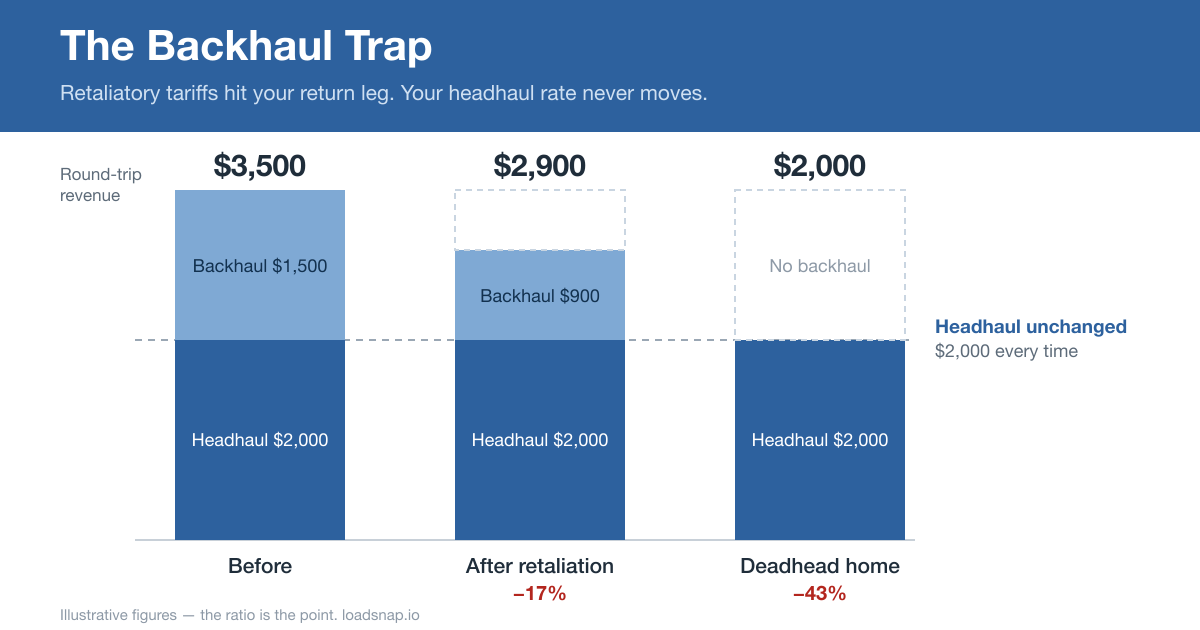
Here’s the math. These numbers are illustrative — plug in your own — but the ratio is the lesson:
| Before | After retaliation | Deadhead scenario | |
|---|---|---|---|
| Headhaul (outbound) | $2,000 | $2,000 | $2,000 |
| Backhaul (return) | $1,500 | $900 | $0 |
| Round-trip revenue | $3,500 | $2,900 | $2,000 |
| Change | — | −17% | −43% |
Look at the headhaul row. It never changes. Your outbound rate is exactly as healthy as it was, the broker is just as happy, the lane looks fine on your rate sheet — and you are running the same cycle for up to 43% less money.
This is why carriers get blindsided. You cannot see a retaliation shock by looking at outbound rates. The damage is entirely on the return leg, and if you evaluate lanes one direction at a time, which most carriers do, it’s invisible until the bank balance says otherwise.
The rule that fixes it: price the round trip, not the lane.
If your backhaul out of a region has thinned, your headhaul into it has to carry the whole cycle. In the example above, holding your original economics means the outbound needs to move from $2,000 to roughly $2,900 — or you need to stop running the lane. Those are the only two honest answers. “The outbound still pays well” is not one of them.
Practically, that means every lane on your board gets evaluated as a loop:
- What’s the realistic return rate today, not last quarter?
- How many hours until I’m loaded again?
- What’s my revenue per working hour for the whole cycle, including border dwell?
A lane that wins on revenue-per-mile and loses on revenue-per-cycle is a lane that’s slowly draining you.
What it means for your equipment
Trade measures target specific commodity categories, so the shock is never evenly distributed. Broadly:
Flatbed and step deck are the most directly exposed. Metals, building materials, machinery, and industrial equipment are perennial targets for trade measures on both sides of the border. Flatbed carriers feel policy changes first and hardest — but also recover first when exemptions land.
Reefer is exposed through agriculture. Produce and protein are frequent retaliation targets precisely because they’re politically visible. Reefer carriers should watch the export leg carefully — agricultural retaliation is a textbook backhaul killer.
Dry van is the most insulated in the short run and the most exposed to the inventory cycle. Van carriers usually don’t feel the tariff directly; they feel the pull-forward surge and the air pocket that follows, amplified by retailers over-correcting their inventory positions.
If you run a mixed fleet, this is an argument for keeping it mixed. Concentration in one equipment type is a concentration in one policy exposure.
The decision playbook
Six moves, roughly in order of how quickly you can do them.
1. Re-underwrite your lane list quarterly, not annually. Most carriers set a target lane list and revisit it once a year. In a volatile policy environment, a year is far too slow — a gateway shift can be most of the way done in that time. Pull your last 90 days, sort by revenue per working hour for the round trip, and be honest about what’s declining.
2. Price the round trip. Covered above. This single change to how you quote will do more than everything else on this list.
3. Build a second lane set before you need it. The worst time to develop a new lane is when your primary lane has already collapsed — you’ll be bidding against everyone else who just lost the same lane, with no relationships and no history. Run a few loads a month in an adjacent lane while you don’t need it. You’re buying an option, and the premium is small.
4. Diversify brokers ahead of the shift, not after. If three brokers account for most of your revenue and they’re concentrated in one commodity, you have a policy exposure disguised as a customer list. Add relationships in categories with different exposure.
5. Put border dwell in your terms. Explicit detention terms, in writing, before dispatch. If a broker won’t agree to them on a cross-border lane, that’s information about how they expect the lane to run.
6. Separate signal from noise. Announcements are not implementations. Proposed measures frequently get delayed, narrowed, or exempted before they take effect, and trading on the announcement means trading on something that may never happen. Watch for the effective date and the exemption list — that’s when freight actually moves.
Indicators worth watching
You don’t need a subscription to an economics service. Most of what matters is public and free:
- Border crossing and port volume data — CBP and CBSA publish crossing statistics; Statistics Canada and the U.S. Census Bureau publish trade flows by commodity and partner. This is where a gateway shift shows up first.
- Load-to-truck ratios by region — available through DAT and LoadLink. Watch the ratio between your outbound and return regions. A widening gap is the backhaul trap forming.
- Spot-to-contract spread — when spot runs well above contract, capacity is tight and a surge is live. When it collapses below, you’re in the air pocket.
- Manufacturing sentiment — the ISM and S&P Global PMI new-orders components lead freight volume by a couple of months.
- The exemption list — genuinely the highest-value thing to watch, and the least watched. Exemptions and carve-outs are where the real economics get decided, long after the headline rate is set.
The point of watching these isn’t to forecast. It’s to notice a shift six weeks before your revenue does.
Where speed becomes the edge
Here’s the part that connects all of this to what you actually do on a Tuesday morning.
When your lane map is stable, you win on relationships. You know your brokers, they know your trucks, and a lot of freight moves before it ever hits a board.
When trade policy redraws the map, that advantage resets. You’re bidding into lanes where nobody knows you, against carriers who are just as displaced as you are. Relationships take months to rebuild. In the meantime, the load goes to whoever gets a credible, complete, professional response in front of the broker first.
That’s not a relationship problem. It’s a response-time problem — and response time is a solvable one.
The mechanics matter more than most carriers think. Seeing a load, opening a new email, retyping the load number, origin, destination, equipment, and your MC and insurance details, then sending — that’s a couple of minutes per load. Do it forty times a day and it’s over an hour of typing, and you’re still slower than the carrier who replied in fifteen seconds.
This is the specific problem LoadSnap was built for: it’s a Chrome extension that sits on top of LoadLink, DAT, and Truckstop and sends a personalized, templated email to the broker in one click, with the load’s details filled in automatically. Same information, same professionalism, without the retyping. It also pulls up the route in Google Maps from the load itself, so you can sanity-check the run before you commit — which matters more than usual when you’re quoting a lane you haven’t run before.
None of that predicts a tariff. What it does is compress the gap between deciding to chase a new lane and actually being in the running for loads in it — which, when the map is being redrawn, is the constraint that binds.
If you want the underlying tactics, we’ve covered them in more depth elsewhere:
- Complete Guide to Finding Loads for Truck Drivers — search strategy and rate negotiation
- DAT vs Truckstop vs LoadLink — which board covers which lanes, which matters a lot when you’re expanding your map
- 10 Copy-Paste Email Templates for Freight Dispatchers — including first-contact templates for brokers who don’t know you
- How to Automate Your Dispatch Workflow — the full workflow end to end
Your next 30 days
A short, concrete checklist:
- Pull your last 90 days and calculate round-trip revenue per working hour for your top 10 lanes
- Identify which of those lanes depend on a backhaul that could be hit by retaliation
- Re-quote those lanes on round-trip economics and decide: raise the headhaul, or exit
- Pick two adjacent lanes as a hedge and run at least one load in each
- Add explicit detention terms to your cross-border rate confirmations
- Bookmark the crossing-volume and load-to-truck data sources above; check monthly
- Cut your average broker response time — whatever it takes to get there
None of that requires knowing what happens next. That’s the point. The carriers who come through a policy shift in good shape are almost never the ones who predicted it correctly. They’re the ones whose lane economics were honest, whose cost base was flexible, and who could re-aim quickly.
FAQ
Do tariffs reduce total freight volume? Usually less than expected, and rarely evenly. The larger effect is redistribution — different origins, different gateways, different lanes. Total tonnage often changes modestly while individual carriers see dramatic swings depending on which side of the shift they’re on.
Should I raise my rates when tariffs are announced? Not on the announcement. Announcements are frequently delayed, narrowed, or exempted. Raise rates when your round-trip economics have actually changed — when your backhaul has thinned or your border dwell has lengthened. Price the change you can measure, not the one you read about.
What’s the single most common mistake? Evaluating lanes in one direction. It hides retaliation damage completely, because the outbound rate stays healthy while the cycle quietly loses a third of its revenue.
I’m an owner-operator, not a fleet. Does this apply? More, not less. A fleet can absorb one bad lane across many trucks. If you run one truck and your primary lane breaks, that’s your entire revenue. Building a second lane set matters most at the smallest scale.
How far ahead can any of this actually be seen? Sourcing shifts show up in trade and crossing data months before they show up in your revenue. Pull-forward surges are visible in real time if you know to distrust them. Retaliation effects show up in load-to-truck ratios on the return leg within weeks. None of it requires forecasting policy — only watching freight.
The bottom line
Trade policy will keep moving, and no amount of reading will tell you reliably what’s next. That’s fine. You don’t need to know what’s next — you need a business that doesn’t depend on knowing.
Three things get you there. Price round trips instead of lanes, so retaliation can’t hide in your backhaul. Keep your lane list under quarterly review and a hedge lane warm, so a gateway shift finds you already halfway moved. And be fast enough on first contact that you can compete in lanes where nobody knows your name yet.
The headline isn’t the decision. The round trip is.
Running cross-border and looking to cut your response time on unfamiliar lanes? LoadSnap sends templated, personalized broker emails in one click from LoadLink, DAT, and Truckstop. Free one-month trial, no credit card required.