
You are at twenty trucks. A driver you have known for years wants to come over with his own tractor, and after eighteen months of a market that punished everyone, the rates finally make it look sensible. So you build the spreadsheet. Payment. Insurance. Plates. Fuel. His pay. It works.
Then truck twenty-one lands and your UCR bill goes from $276 to $963.
That line is not in anybody’s spreadsheet.
What happened
FMCSA published the 2027 Unified Carrier Registration fee schedule in the Federal Register on September 1. Fees rise an average of 20 percent, with increases running from $9 to $9,329 per entity depending on bracket. The 2027 registration portal opens October 1, 2026.
Four weeks out. But the increase is the boring half of this. The bracket structure is the half that has been quietly shaping small-fleet economics the whole time, and almost nobody prices it.
UCR is a step, not a rate
Nearly every cost you carry scales with the fleet. Insurance is per truck. Plates are per truck. IFTA is per mile. Add a truck, add a cost, and your cost per truck barely moves.
UCR does not behave that way. It is one flat fee per bracket, and the brackets are wide.
Here are the 2026 fees, as published by the UCR Plan:
| Bracket | Commercial motor vehicles | Fee |
|---|---|---|
| 1 | 0–2 | $46 |
| 2 | 3–5 | $138 |
| 3 | 6–20 | $276 |
| 4 | 21–100 | $963 |
| 5 | 101–1,000 | $4,592 |
| 6 | 1,001+ | $44,836 |
Now do the division nobody does.
| Fleet | Fee | Cost per truck |
|---|---|---|
| 2 trucks | $46 | $23.00 |
| 3 trucks | $138 | $46.00 |
| 5 trucks | $138 | $27.60 |
| 6 trucks | $276 | $46.00 |
| 20 trucks | $276 | $13.80 |
| 21 trucks | $963 | $45.86 |
| 100 trucks | $963 | $9.63 |
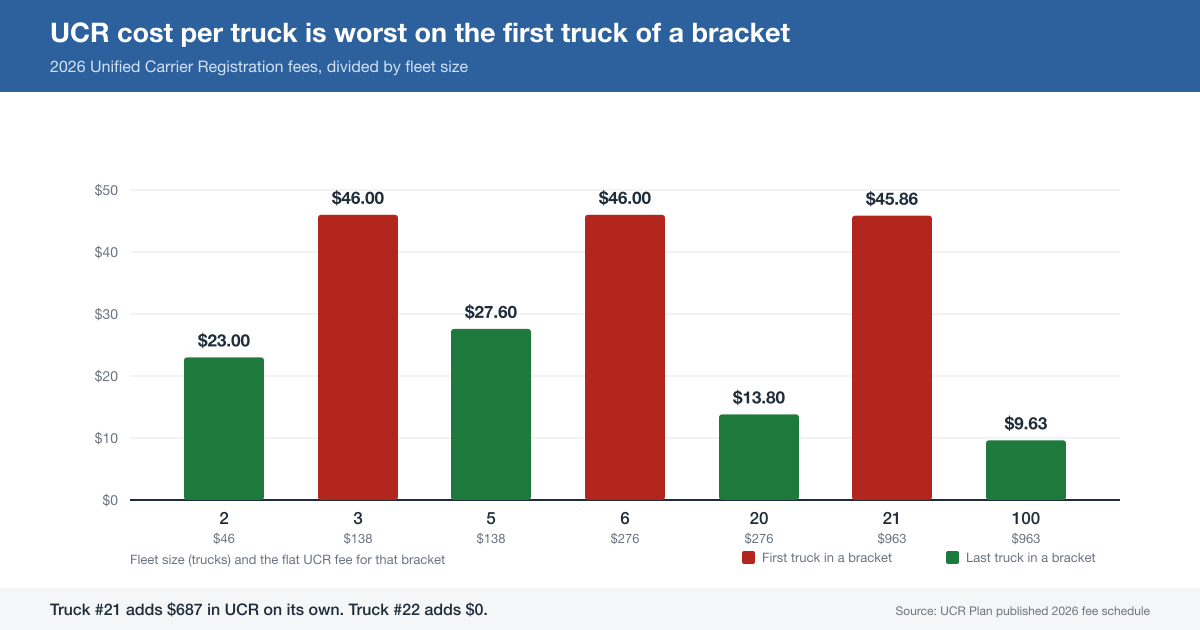
Read the right-hand column top to bottom and the shape jumps out. Your UCR cost per truck is at its worst on the first truck of a bracket and its best on the last.
At twenty trucks you are paying $13.80 a truck. At twenty-one you are paying $45.86 — more than triple, for one additional unit. Truck twenty-one carries $687 of UCR by itself. Truck twenty-two carries nothing.
The same cliff sits at the small end, and proportionally it bites harder. Going from two trucks to three takes you from $46 to $138: a $92 jump on exactly the kind of operation where $92 is a real decision.
What 2027 does to it
Every cliff gets roughly twenty percent steeper.
Apply the published 20 percent average to the 2026 bracket three and bracket four fees and the 20-to-21 step goes from $687 to somewhere near $830. The 2-to-3 step goes from $92 to about $111.
That is arithmetic on the announced average, not a quoted per-bracket figure — the final numbers per bracket sit in the rule itself. The direction is not in question.
Seven things to check before October 1
- Know your bracket, not your truck count. Two trucks and five trucks cost the same. Five and six do not.
- Find your distance to the next boundary. The numbers that matter are 2, 5, 20, 100 and 1,000. Everything between them is free.
- Price a marginal truck with the bracket jump included. Truck twenty-one is not the same purchase as truck twenty-two, and the difference is $687 before it turns a wheel.
- Remember UCR is not carriers only. Brokers, freight forwarders and leasing companies register too. Running a brokerage authority beside your trucks means a separate registration.
- Register early. The portal opens October 1. An inactive UCR is the sort of thing that surfaces at a scale house, at the worst possible hour.
- Budget the increase in September, not January. Twenty percent on bracket four is roughly $200. On bracket five it is roughly $900.
- Confirm the vehicle count you are actually reporting. Your bracket follows the count on your filing. A stale count puts you in the wrong row in one direction or the other, and only one of those directions is cheap.
The arithmetic, copyable
Fleet size:                    20 trucks
2026 UCR fee:                  $276
Cost per truck:                $13.80

Add one truck:                 21 trucks
2026 UCR fee:                  $963
Cost per truck:                $45.86

UCR cost of truck #21:         $687
UCR cost of truck #22:         $0
UCR cost of truck #23:         $0
Run that with your own numbers. If $687 changes the answer on a marginal truck, you want to find that out before you sign, not when the invoice shows up.
Do this today
Open your last MCS-150, read the vehicle count you filed, and find that number in the bracket table above. One number, one row, two minutes.
If you are sitting within two trucks of a boundary, the growth decision you make this quarter has a cost attached to it that is not in your per-truck model. That is the whole point of this post.
The part you can still move
A bracket jump is a fixed cost. You cannot negotiate it, you cannot prorate it, and you cannot spread it across the year. The same is true of most of what makes up your cost base — as we covered in linehaul versus all-in rates, the number on the rate confirmation hides more structure than it shows. And with spot and contract rates closing the gap, the room to simply out-earn a cost increase is narrower than it was in the spring.
What is left is utilisation: how many of the right loads each truck runs, which comes down to how quickly a complete, credible reply lands in a broker’s inbox.
That is the mechanism LoadSnap sits on. It is a Chrome extension that runs on LoadLink, DAT and Truckstop — you pick a load, and it fills your own template with that load’s details and sends it, without you retyping the reference number, the lane or the equipment. It will not make truck twenty-one cheaper. It makes the day you are paying for that truck go a little further.